

Special Enrollment Period Medicare: Complete 2026 Guide
Introduction
Missing your Medicare enrollment deadline doesn’t always mean you have to wait until the next enrollment period. In many situations, Medicare offers a Special Enrollment Period (SEP) that allows eligible people to enroll or change their coverage outside the standard enrollment windows.
Whether you’ve recently retired, moved to a new area, lost employer health insurance, or experienced another qualifying life event, understanding the Special Enrollment Period Medicare rules can help you avoid costly penalties and prevent gaps in healthcare coverage.
This comprehensive guide explains who qualifies, how long your enrollment window lasts, which Medicare plans are affected, and the steps you should take to enroll successfully.
Quick Answer
A Special Enrollment Period Medicare is a limited time outside the normal enrollment periods when eligible individuals can enroll in or change Medicare coverage after experiencing a qualifying life event.
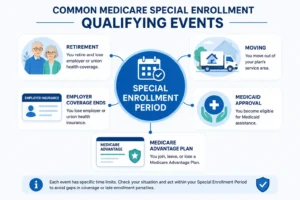
Common qualifying events include:
- Losing employer-sponsored health coverage
- Moving to a new service area
- Qualifying for Medicaid
- Leaving employer coverage after retirement
- Changes to your Medicare plan
- Certain emergency or exceptional situations recognized by Medicare
Each qualifying event has its own enrollment deadline, so acting quickly is essential.
Key Takeaways
✅ A Special Enrollment Period lets eligible people enroll outside normal Medicare enrollment periods.
✅ Most SEPs require a qualifying life event.
✅ Different events have different enrollment deadlines.
✅ Some SEPs apply only to Parts A and B, while others apply to Medicare Advantage and Part D.
✅ Missing your SEP could delay coverage and lead to lifetime late enrollment penalties.
✅ Employer health coverage is one of the most common reasons people qualify.
What Is a Special Enrollment Period Medicare?
A Special Enrollment Period (SEP) is a specific timeframe that allows eligible individuals to enroll in Medicare or make changes to their Medicare coverage after certain life events.
Unlike the Initial Enrollment Period or the Annual Open Enrollment Period, an SEP is triggered by a qualifying circumstance rather than a fixed calendar date.
The purpose of an SEP is to ensure that people don’t lose access to healthcare simply because their life situation changes unexpectedly.
Why Medicare Offers Special Enrollment Periods
Life doesn’t always follow a predictable schedule.
Someone may:
- Continue working after age 65
- Lose employer-sponsored insurance
- Relocate to another state
- Become eligible for financial assistance
- Experience changes in their Medicare plan
Without Special Enrollment Periods, these individuals might have to wait months before enrolling, potentially leaving them without health coverage.
Who Can Benefit Most?
Special Enrollment Periods are especially valuable for:
- Retirees leaving employer coverage
- Seniors relocating to another county or state
- Individuals moving into skilled nursing facilities
- People qualifying for Medicaid
- Medicare beneficiaries whose plans discontinue service
Table: Standard Enrollment vs Special Enrollment
| Feature | Initial Enrollment | Open Enrollment | Special Enrollment |
| Fixed Dates | Yes | Yes | No |
| Qualifying Event Needed | No | No | Yes |
| Available Every Year | No | Yes | Only when eligible |
| Can Avoid Penalties | Sometimes | No | Often Yes |
| Coverage Changes Allowed | Limited | Yes | Depends on event |
Expert Insight
Many people mistakenly believe that missing their Initial Enrollment Period means they must wait until the General Enrollment Period. In reality, if you qualify for a Special Enrollment Period, you may be able to enroll immediately without paying a late enrollment penalty.

Who Qualifies for a Special Enrollment Period?
Not everyone qualifies for an SEP. Medicare only grants these enrollment opportunities after specific qualifying life events.
Below are the most common situations that make you eligible.
You Lose Employer Health Insurance
One of the most common qualifying events occurs when you retire or your employer-sponsored group health coverage ends.
If you’ve delayed enrolling in Medicare because you were covered through active employment, you generally receive a Special Enrollment Period to sign up after that coverage ends.
You Move to a New Location
Moving can affect the Medicare plans available in your area.
You may qualify for an SEP if you:
- Move outside your current plan’s service area
- Return to the U.S. after living abroad
- Move into or out of a skilled nursing facility
- Move into assisted living under qualifying circumstances
You Become Eligible for Medicaid
Individuals who newly qualify for Medicaid may receive additional opportunities to enroll in or switch Medicare plans.
This coordination helps beneficiaries maintain affordable healthcare coverage.
Your Medicare Plan Changes
Sometimes your Medicare Advantage or Prescription Drug Plan changes because of decisions made by the insurance provider.
Examples include:
- Plan termination
- Contract cancellation
- Reduced service area
- Loss of prescription drug coverage
When this happens, Medicare generally provides an SEP to select a new plan.
Table: Common Qualifying Events
| Qualifying Event | Usually Eligible for SEP? |
| Retirement | ✅ Yes |
| Loss of Employer Insurance | ✅ Yes |
| Moving | ✅ Yes |
| Medicaid Eligibility | ✅ Yes |
| Plan Ends | ✅ Yes |
| Vacation | ❌ No |
| Forgot to Enroll | ❌ No |
Expert Tip
Keep records of your qualifying event, such as employer coverage termination letters or proof of address changes. Medicare may request documentation before approving your Special Enrollment Period.
How Long Does a Medicare Special Enrollment Period Last?
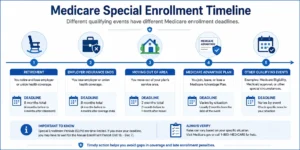
The length of a Special Enrollment Period depends on the qualifying event that triggered it.
Some enrollment windows last 2 months, while others extend to 8 months or longer under specific Medicare rules.
Understanding your deadline is critical because missing it could result in delayed coverage or permanent late enrollment penalties.
Medicare Special Enrollment Period Deadlines
One of the biggest misconceptions about the Special Enrollment Period Medicare is that every SEP follows the same timeline. In reality, the deadline depends on the qualifying life event.
The clock usually starts on the date your qualifying event occurs, although some SEPs begin before the event if Medicare allows advance plan selection.
Understanding your specific deadline can help you avoid losing coverage or paying lifelong late enrollment penalties.
8-Month Special Enrollment Period for Part A & Part B
If you delayed enrolling in Medicare because you were covered by an employer’s group health plan through active employment, you generally receive an 8-month Special Enrollment Period.
This SEP usually begins when either:
- Your employment ends, or
- Your employer-sponsored health coverage ends,
whichever happens first.
During this period, you can enroll in:
- Medicare Part A (if you haven’t already)
- Medicare Part B
Enrolling within this window generally helps you avoid the Medicare Part B late enrollment penalty.
2-Month Special Enrollment Period for Medicare Advantage & Part D
Many Special Enrollment Periods for Medicare Advantage (Part C) and Prescription Drug Plans (Part D) last approximately 2 months.
These often apply after events such as:
- Losing employer drug coverage
- Moving outside your plan’s service area
- Your Medicare Advantage plan ending
- Your prescription drug plan being discontinued
The exact timeframe depends on the specific qualifying event.
Different Events, Different Deadlines
Because Medicare has multiple Special Enrollment Period categories, deadlines are not identical.
Some events allow enrollment before the change occurs, while others begin only after the qualifying event has happened.
Always verify your specific SEP timeline before delaying enrollment.
Comparison Table: Common SEP Timelines
| Qualifying Event | Typical Enrollment Window | Coverage Affected |
| Employer Coverage Ends | Up to 8 Months | Part A & Part B |
| Moving to New Area | Usually 2 Months | Medicare Advantage / Part D |
| Plan Leaves Medicare | Usually 2 Months | Part C & Part D |
| Medicaid Eligibility | Varies | Multiple Plans |
| Exceptional Circumstances | Case-by-case | Depends on CMS Rules |
Expert Tip
Don’t wait until the last week of your Special Enrollment Period. Applying early provides time to resolve documentation issues and helps reduce the risk of delayed coverage.
Qualifying Life Events That Trigger a Medicare Special Enrollment Period
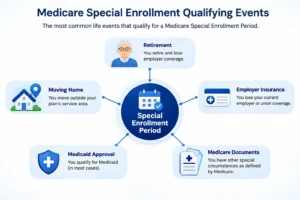
A Special Enrollment Period isn’t available simply because someone missed their enrollment deadline.
Instead, Medicare requires a qualifying life event that changes your healthcare situation.
Below are the most common qualifying events.
1. Losing Employer Health Coverage
Many Americans continue working after age 65.
If you delayed Medicare because you had employer-sponsored health insurance, losing that coverage is one of the most common reasons to qualify for an SEP.
This includes:
- Retirement
- Employer coverage ending
- COBRA ending (in certain situations, note that COBRA itself generally does not extend the Part B SEP)
- Employer reducing health benefits
2. Moving to a New Address
Moving can affect which Medicare Advantage and Part D plans are available.
Examples include:
- Moving outside your current plan’s service area
- Returning to the United States
- Moving into a skilled nursing facility
- Leaving a long-term care facility
- Relocating to another county where your current plan isn’t offered
3. Losing Medicaid Eligibility
Some beneficiaries qualify for both Medicare and Medicaid.
If your Medicaid status changes, Medicare may provide a Special Enrollment Period to help you select new coverage.
4. Your Medicare Plan Changes
Insurance companies sometimes make changes beyond your control.
Examples include:
- Your Medicare Advantage plan ends.
- Medicare terminates the contract.
- Your Part D prescription plan closes.
- Your plan no longer serves your area.
5. Other Exceptional Circumstances
CMS recognizes additional situations that may qualify for an SEP.
Examples may include:
- Natural disasters
- Federal emergencies
- Administrative errors
- Certain legal or government-related situations
- Other exceptional conditions approved by Medicare
Table: Most Common Qualifying Events
| Qualifying Event | SEP Available | Common Coverage Impact |
| Retirement | ✅ Yes | Part A & Part B |
| Employer Coverage Ends | ✅ Yes | Part A & Part B |
| Move to New Area | ✅ Yes | Medicare Advantage |
| Plan Ends | ✅ Yes | Part C & Part D |
| Medicaid Changes | ✅ Yes | Multiple Plans |
| Natural Disaster | Possible | Depends on CMS |
Real-World Example
Sarah, age 67, continued working after turning 65 because she had employer health insurance.
When she retired, her employer coverage ended.
Instead of waiting for the next General Enrollment Period, she used her 8-month Special Enrollment Period to enroll in Medicare Part B, avoiding a permanent late enrollment penalty.
Which Parts of Medicare Are Covered Under a Special Enrollment Period?
Many people assume that one Special Enrollment Period applies to every Medicare program.
However, eligibility rules differ depending on which part of Medicare you’re enrolling in or changing.
Medicare Part A
If you delayed enrolling because you had qualifying employer coverage, you may enroll during your SEP.
Medicare Part B
Part B is one of the most common reasons people use an SEP.
Enrolling within the allowed timeframe can help avoid permanent late enrollment penalties.
Medicare Advantage (Part C)
Many Special Enrollment Periods allow beneficiaries to:
- Join a Medicare Advantage plan
- Switch Medicare Advantage plans
- Return to Original Medicare (when permitted by the applicable SEP)
Eligibility depends on the qualifying event.
Medicare Part D
Prescription drug coverage can also be changed during many Special Enrollment Periods.
Common reasons include:
- Losing creditable prescription drug coverage
- Moving to another service area
- Plan termination
- Medicaid eligibility changes
Comparison Table
| Medicare Part | SEP Available? | Common Reason |
| Part A | ✅ Yes | Employer Coverage Ends |
| Part B | ✅ Yes | Retirement |
| Part C | ✅ Yes | Move or Plan Changes |
| Part D | ✅ Yes | Drug Coverage Changes |
Expert Insight
Many Medicare beneficiaries qualify for more than one Special Enrollment Period during retirement. Understanding which Medicare part is affected prevents unnecessary enrollment mistakes and ensures continuous healthcare coverage.

How to Apply for a Medicare Special Enrollment Period
If you believe you qualify for a Special Enrollment Period, acting promptly can help prevent coverage gaps.
Although the exact process varies depending on your qualifying event, the steps are generally straightforward.
Step 1: Confirm Your Qualifying Event
Determine which life event makes you eligible for an SEP.
Step 2: Gather Supporting Documents
Examples may include:
- Employer coverage termination letter
- Proof of address change
- Medicaid eligibility notice
- Documentation showing plan termination
Step 3: Submit Your Enrollment Request
Depending on your situation, you may apply through:
- The Social Security Administration (for Parts A and B)
- Medicare-approved plan providers (for Part C or Part D)
- Other approved enrollment channels
Step 4: Monitor Your Coverage Start Date
Review all confirmation notices and verify when your new coverage becomes effective to avoid gaps.
Best Practices
✔ Keep copies of every enrollment document.
✔ Don’t assume every life event qualifies.
✔ Submit paperwork before your SEP expires.
✔ Verify your effective coverage date.
✔ Contact Medicare or Social Security if you’re unsure about your eligibility.
Common Medicare Special Enrollment Period Mistakes to Avoid
Even if you qualify for a Special Enrollment Period Medicare, simple mistakes can delay your coverage or result in unnecessary penalties. Understanding these common errors can help you complete the enrollment process with confidence.
Mistake #1: Assuming Everyone Qualifies
A Special Enrollment Period is only available if you experience a qualifying life event recognized by Medicare.
Forgetting to enroll or simply changing your mind does not usually qualify you for an SEP.
How to avoid it:
- Review Medicare’s qualifying events.
- Confirm your eligibility before submitting an application.
Mistake #2: Missing Your Enrollment Deadline
Each SEP has its own enrollment window.
Waiting too long can mean losing your opportunity to enroll until the next eligible period.
How to avoid it:
- Mark important dates on your calendar.
- Apply as soon as your qualifying event occurs.
Mistake #3: Not Keeping Documentation
Many Special Enrollment Periods require proof of the qualifying event.
Missing paperwork can slow down your application.
Examples include:
- Employer coverage termination notice
- Proof of relocation
- Medicaid eligibility letter
- Medicare plan termination notice
Mistake #4: Confusing COBRA with Medicare Coverage
Many retirees mistakenly believe that remaining on COBRA allows them to delay Medicare enrollment without consequences.
However, COBRA coverage generally does not replace the need to enroll in Medicare when your Special Enrollment Period applies. Delaying enrollment could lead to late enrollment penalties or gaps in coverage.
Mistake #5: Choosing the Wrong Medicare Plan
Qualifying for an SEP gives you an opportunity to review your healthcare needs.
Selecting a plan based only on the monthly premium may leave you with higher overall healthcare costs.
Consider:
- Monthly premiums
- Deductibles
- Provider networks
- Prescription drug coverage
- Out-of-pocket limits
Table: Common Mistakes and Solutions
| Common Mistake | Possible Consequence | Recommended Solution |
| Missing deadline | Coverage delay | Apply immediately |
| No documentation | Enrollment delay | Save all records |
| Assuming everyone qualifies | Application denial | Verify eligibility |
| Ignoring provider networks | Limited doctor access | Compare plans carefully |
| Confusing COBRA with Medicare timing | Possible penalties | Understand SEP rules before delaying enrollment |
Expert Tips for a Successful Medicare Special Enrollment
Navigating Medicare can be easier with the right preparation. These best practices can help you make informed decisions and reduce the risk of delays.
Keep Important Documents Organized
Maintain copies of:
- Employer health coverage letters
- Medicare notices
- Social Security correspondence
- Address change documentation
- Prescription drug coverage records
Having these documents ready can speed up the enrollment process if Medicare requests verification.
Compare Plans Before Making Changes
Before switching plans, review:
- Monthly premium
- Annual deductible
- Coinsurance
- Maximum out-of-pocket costs
- Prescription drug formulary
- Preferred hospitals and physicians
Choosing the lowest premium isn’t always the most cost-effective option.
Review Your Coverage Every Year
Even after using a Special Enrollment Period, review your Medicare coverage annually.
Healthcare needs and plan benefits can change over time.
Seek Professional Guidance
If you’re unsure about your eligibility or plan options, consider speaking with:
- A licensed Medicare insurance agent
- Your State Health Insurance Assistance Program (SHIP)
- Social Security (for Parts A and B enrollment)
- Medicare customer service
Professional guidance can help you understand your options and avoid costly mistakes.
Decision Framework: Do You Qualify for a Medicare Special Enrollment Period?
Use this simple checklist to evaluate whether you may qualify for a Special Enrollment Period.
Medicare SEP Decision Checklist
✅ Did you recently retire?
✅ Did your employer health coverage end?
✅ Have you moved outside your Medicare Advantage plan’s service area?
✅ Has your Medicare plan been discontinued?
✅ Did you recently qualify for Medicaid?
✅ Are you affected by a Medicare-approved exceptional circumstance?
If you answered “Yes” to one or more questions, you may qualify for a Special Enrollment Period. Review the applicable Medicare rules and deadlines before enrolling.
Frequently Asked Questions (FAQs)
What is a Special Enrollment Period in Medicare?
A Special Enrollment Period is a limited window that allows eligible individuals to enroll in or change Medicare coverage after experiencing a qualifying life event.
Who qualifies for a Medicare Special Enrollment Period?
Common qualifying events include:
- Losing employer-sponsored health insurance
- Moving outside your plan’s service area
- Medicare plan changes
- Certain Medicaid eligibility changes
- Other Medicare-approved exceptional circumstances
How long does a Medicare Special Enrollment Period last?
The duration varies depending on the qualifying event.
For example, individuals leaving employer-sponsored coverage often have an 8-month SEP to enroll in Medicare Part B, while many Medicare Advantage and Part D SEPs last around 2 months.
Can I avoid Medicare late enrollment penalties with a Special Enrollment Period?
In many situations, yes.
If you qualify for an SEP and enroll within the required timeframe, you may avoid late enrollment penalties that would otherwise apply.
Can I switch Medicare Advantage plans during a Special Enrollment Period?
Yes.
Many qualifying events allow beneficiaries to join, switch, or leave a Medicare Advantage plan, depending on the specific SEP rules.
Does moving to another state qualify for a Medicare Special Enrollment Period?
Often, yes.
Moving outside your current Medicare Advantage or Part D plan’s service area is one of the most common qualifying events.
Is the Medicare Special Enrollment Period available every year?
No.
Unlike the Annual Open Enrollment Period, a Special Enrollment Period is only available after specific qualifying life events.
Conclusion: Understanding the Special Enrollment Period Medicare Rules
A Special Enrollment Period Medicare gives eligible individuals an important opportunity to enroll in or change Medicare coverage outside the normal enrollment windows.
Whether you are retiring, losing employer health insurance, moving to a new area, or experiencing another qualifying life event, understanding SEP rules can help you avoid coverage gaps and unnecessary penalties.
The most important steps are:
- Identify your qualifying life event
- Understand your specific enrollment deadline
- Prepare required documentation
- Compare available Medicare coverage options
- Submit your enrollment request before your SEP expires
Medicare decisions can have long-term financial and healthcare consequences. Taking action early and