Liability vs Full Coverage: Complete Car Insurance Guide for 2026
Choosing car insurance can be confusing. Many drivers wonder whether they should buy basic liability coverage or pay more for what is often called full coverage.
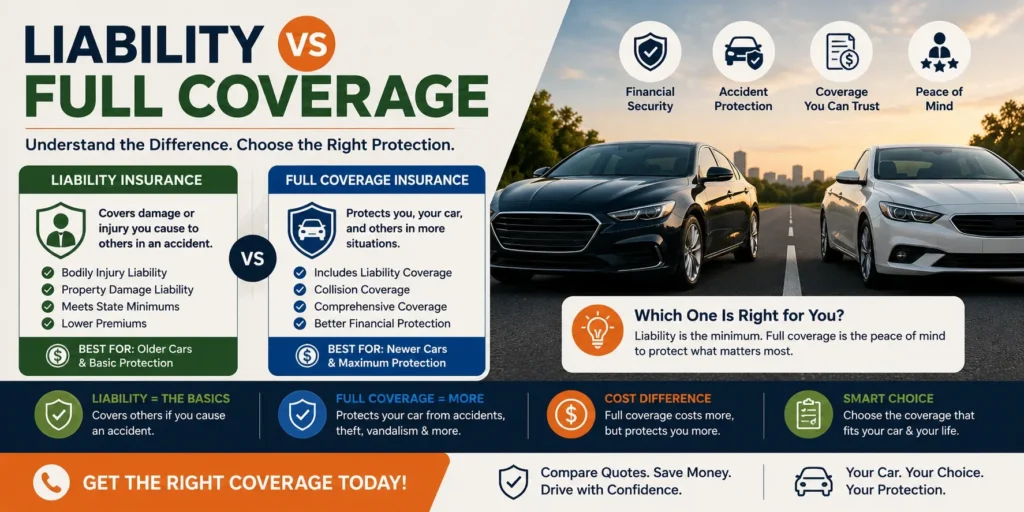
The key difference is simple. Liability insurance mainly protects you financially when you cause an accident that injures another person or damages their property. Full coverage usually refers to liability insurance combined with collision and comprehensive coverage.
The right choice depends on your state requirements your vehicle’s value your budget and whether you have a car loan or lease.
This guide explains liability vs full coverage in simple terms. You will learn what each option covers what it does not cover how costs differ and how to decide which protection makes sense for you.
Quick Answer: Liability vs Full Coverage
Liability insurance covers damage and injuries you are legally responsible for causing to other people. Full coverage generally adds collision and comprehensive insurance to liability coverage which can also help protect your own vehicle.
Here is the basic difference:
| Feature | Liability Coverage | Full Coverage |
| Covers injuries you cause to others | Yes | Yes |
| Covers property damage you cause | Yes | Yes |
| Pays to repair your car after an at-fault crash | No | Usually yes with collision |
| Covers theft | No | Usually yes with comprehensive |
| Covers vandalism | No | Usually yes with comprehensive |
| Covers weather damage | No | Usually yes with comprehensive |
| Required by most states | Usually required | Usually not required by state law |
| Required by lenders | Usually no | Often yes for financed vehicles |
| Usually costs less | Yes | No |
One important point is that “full coverage” is not a single insurance policy. The term is commonly used to describe a combination of coverages. The exact protection depends on the policy.
What Is Liability Car Insurance?
Liability car insurance helps pay for certain costs when you are legally responsible for an accident.
Most liability coverage has two main parts.
Bodily Injury Liability
Bodily injury liability can help pay for injuries you cause to another person in a covered accident.
Depending on your policy and state rules it may help with:
- Medical expenses
- Lost wages
- Legal defense costs
- Settlement costs
- Other injury-related expenses
The coverage generally applies to the other party rather than your own injuries.
Property Damage Liability
Property damage liability helps pay for damage you cause to someone else’s property.
For example, you may hit:
- Another vehicle
- A fence
- A building
- A mailbox
- Other property
Your policy can help pay covered damages up to your policy limit.
What Does Liability Insurance Not Cover?
Liability insurance is important but it does not protect you from every type of financial loss.
Generally, liability-only coverage does not pay to repair your own vehicle after an accident you caused.
It also does not typically cover your vehicle for:
- Theft
- Vandalism
- Hail
- Flood damage
- Falling objects
- Animal collisions
- Fire
- Other comprehensive losses
Your policy may also exclude other situations depending on its terms.
How Liability Coverage Limits Work
Liability coverage is usually shown using three numbers.
For example:
25/50/25
These numbers commonly represent:
| Number | Meaning |
| First 25 | $25,000 bodily injury coverage per person |
| Second 50 | $50,000 bodily injury coverage per accident |
| Last 25 | $25,000 property damage coverage per accident |
The exact requirements differ by state.
State minimum coverage may be enough to meet legal requirements but it may not provide enough protection for every accident.
If damages exceed your policy limits you could potentially be responsible for additional costs.
What Is Full Coverage Car Insurance?
The term full coverage is commonly used to describe a policy that combines liability insurance with:
- Collision coverage
- Comprehensive coverage
Other optional coverages may also be included depending on the insurer and policy.
Collision Coverage
Collision insurance can help pay to repair or replace your vehicle after a covered collision.
This may include an accident involving:
- Another car
- A stationary object
- A tree
- A wall
- A guardrail
Collision coverage usually comes with a deductible.
For example, if your vehicle has $8,000 in covered damage and your collision deductible is $1,000, the insurer may pay the covered amount above the deductible subject to policy terms.
Comprehensive Coverage
Comprehensive insurance can help protect your vehicle against many types of damage that are not caused by a collision.
Examples may include:
- Theft
- Vandalism
- Hail
- Fire
- Falling objects
- Flooding
- Wind damage
- Animal strikes
Like collision coverage, comprehensive insurance usually has a deductible.
What Does Full Coverage Not Cover?
Despite its name full coverage does not mean your car is protected against every possible loss.
It may not cover:
- Mechanical breakdowns
- Normal wear and tear
- Routine maintenance
- Intentional damage
- Personal belongings inside the vehicle
- Certain business uses
- Injuries beyond applicable policy limits
- Losses excluded by the policy
Additional coverage may be needed for certain situations.
For example, personal items stolen from your vehicle may be covered by homeowners or renters insurance rather than auto insurance depending on the circumstances.
Liability vs Full Coverage: Side-by-Side Comparison
| Coverage Feature | Liability Only | Full Coverage |
| Injuries you cause to others | ✓ | ✓ |
| Property damage you cause | ✓ | ✓ |
| Damage to your car from a collision | ✗ | ✓ |
| Theft | ✗ | ✓ with comprehensive |
| Vandalism | ✗ | ✓ with comprehensive |
| Hail damage | ✗ | ✓ with comprehensive |
| Fire damage | ✗ | ✓ with comprehensive |
| Animal collision | ✗ | ✓ with comprehensive |
| Your own vehicle protection | Limited | Broader |
| Typical premium | Lower | Higher |
| State-required | Often | Usually not |
| Lender-required | Usually not | Often |
Coverage varies by insurer and policy so always check your declarations page and policy documents.
Liability vs Full Coverage Cost
One of the biggest differences between these options is price.
Liability-only insurance generally costs less because it provides less protection for your own vehicle.
Full coverage costs more because it adds protection for your vehicle through collision and comprehensive insurance.
Your actual premium can depend on:
- Age
- Driving history
- Location
- Vehicle type
- Vehicle value
- Credit-based insurance score where permitted
- Coverage limits
- Deductibles
- Claims history
- Annual mileage
- Discounts
Example of the Cost Difference
Imagine two drivers with similar profiles.
One chooses liability-only coverage.
The other chooses liability plus collision and comprehensive coverage.
The second driver will often pay more because the insurer is providing additional protection for the vehicle.
However, you should compare actual quotes rather than assuming a fixed price difference.
What Makes Full Coverage More Expensive?
Several factors can increase the cost of full coverage.
Vehicle Value
A more expensive vehicle may cost more to insure.
Repair Costs
Vehicles with expensive parts or complex technology may have higher repair costs.
Deductibles
Lower deductibles can increase your premium.
Higher deductibles may reduce your premium but require you to pay more out of pocket after a covered claim.
Driving History
Tickets accidents and claims may affect your insurance price.
Location
Rates can vary significantly by state city and ZIP code.
Do You Need Liability or Full Coverage?
There is no single answer for every driver.
Your decision should consider your financial situation and the value of your vehicle.
Liability May Make Sense If:
- Your car is older.
- Your vehicle has a low market value.
- You can afford to replace your car yourself.
- You want the lowest possible premium.
- You meet your state’s insurance requirements.
- You do not have a lender requiring additional coverage.
However, choosing liability-only insurance means you may have to pay for your own vehicle repairs after a covered accident if you do not have collision coverage.
Full Coverage May Make Sense If:
- Your vehicle is newer.
- Your car has significant value.
- You cannot easily afford a replacement.
- You have a car loan.
- You lease your vehicle.
- You want protection against theft and weather damage.
- You want coverage for damage to your own vehicle.
When Is Full Coverage Usually Required?
State law generally determines the minimum auto insurance you must carry.
However, a lender or leasing company may require additional coverage.
If you finance a vehicle your lender has a financial interest in the car.
Because of this they may require collision and comprehensive insurance until the loan is paid off.
Once the loan is satisfied you may have more flexibility.
Always check your loan or lease agreement before changing coverage.
How to Decide Between Liability and Full Coverage
Use this simple process.
Step 1: Check Your State Requirements
Find out the minimum coverage required where you live.
Step 2: Check Your Loan or Lease
If you finance or lease your car review your contract.
Step 3: Estimate Your Vehicle’s Value
Consider what your car is worth today rather than what you originally paid.
Step 4: Review Your Emergency Savings
Ask yourself whether you could afford to repair or replace the car after a serious loss.
Step 5: Compare Quotes
Get quotes for liability-only and broader coverage.
Step 6: Compare the Extra Cost
Look at how much more you would pay for collision and comprehensive coverage.
Step 7: Choose Based on Your Risk
Think about your vehicle value your financial position and the risks you face.
Should You Drop Full Coverage on an Older Car?
Dropping full coverage may make sense in some cases but age alone should not be the only factor.
Consider these questions:
- What is your car worth?
- How much is your annual premium?
- What is your deductible?
- Could you replace the vehicle if it were totaled?
- Do you have a loan?
- Is theft common in your area?
- Are severe weather events common where you live?
For example if your car is worth $4,000 and you pay a high annual premium for collision and comprehensive coverage you may decide that liability-only insurance makes more financial sense.
However if you cannot afford to replace the vehicle you may prefer to keep broader coverage.
Liability vs Full Coverage: A Simple Decision Table
| Situation | Potentially Better Option |
| Older low-value car | Liability may be enough |
| Newer expensive vehicle | Full coverage may make sense |
| Financed vehicle | Full coverage is often required |
| Leased vehicle | Full coverage is often required |
| Large emergency fund | Liability may be considered |
| Cannot afford vehicle replacement | Full coverage may be valuable |
| Want theft protection | Full coverage with comprehensive |
| Want crash damage protection | Full coverage with collision |
| Looking for lowest premium | Liability usually costs less |
This table is a starting point rather than a universal rule.
Pros and Cons of Liability Insurance
Pros
- Usually lower premiums
- Meets state minimum requirements when limits are sufficient
- Helps protect you from claims made by others
- Simple coverage structure
- May be suitable for older vehicles
Cons
- Does not generally cover damage to your own car
- Does not typically cover theft
- Does not typically cover weather damage
- You may pay for your own repairs after an at-fault accident
- May leave you with a large financial loss if your vehicle is totaled
Pros and Cons of Full Coverage
Pros
- Provides broader vehicle protection
- Collision coverage can help with covered crash damage
- Comprehensive coverage can help with theft and non-collision losses
- Often required for financed or leased vehicles
- May provide greater financial security
Cons
- Higher premiums
- Deductibles apply to covered vehicle damage
- Does not cover every possible loss
- May not be cost-effective for very low-value vehicles
- You still need to understand policy exclusions
Common Mistakes When Choosing Car Insurance
Choosing Only the Cheapest Policy
The cheapest policy may provide less protection.
Always compare coverage limits and deductibles rather than looking only at the premium.
Assuming Full Coverage Means Everything Is Covered
Full coverage is a common term rather than a guarantee that every loss is covered.
Read your policy carefully.
Buying Only State Minimum Coverage
Minimum limits may satisfy legal requirements but may not fully protect your finances after a serious accident.
Forgetting About Deductibles
A low premium may come with a high deductible.
Make sure you can afford your deductible if you need to file a claim.
Dropping Coverage Without Checking Your Loan
Your lender may require collision and comprehensive coverage.
Check your agreement before making changes.
Other Auto Insurance Coverages to Consider
Liability and full coverage are not the only options.
Depending on your state and insurer you may also consider:
| Coverage | Purpose |
| Uninsured Motorist | Helps protect you after an accident with an uninsured driver |
| Underinsured Motorist | May help when the at-fault driver’s insurance is not enough |
| Personal Injury Protection | May help cover medical costs and other expenses depending on state rules |
| Medical Payments | Helps pay certain medical expenses |
| Rental Reimbursement | May help pay for a rental car after a covered loss |
| Roadside Assistance | Helps with certain roadside emergencies |
| Gap Insurance | May help cover the difference between a car’s value and loan balance after a covered total loss |
Availability and requirements vary by state.
Real-World Example: Choosing the Right Coverage
Consider two drivers.
Driver A owns a 12-year-old vehicle worth about $4,000 and has enough savings to replace it.
The driver may decide that liability coverage is more practical because paying for full coverage may not provide enough value compared with the vehicle’s market value.
Driver B owns a newer vehicle worth $30,000 and has limited savings.
If the vehicle is stolen or seriously damaged Driver B may struggle to replace it.
Full coverage could provide valuable financial protection.
The important difference is not simply the driver’s age. It is the combination of vehicle value financial resources risk and coverage needs.
Key Takeaways
- Liability vs full coverage is mainly a question of how much protection you want.
- Liability insurance generally covers injuries and property damage you cause to others.
- Full coverage commonly combines liability collision and comprehensive insurance.
- Liability-only insurance usually costs less.
- Full coverage generally provides broader protection for your vehicle.
- State laws usually require liability coverage but not full coverage.
- Lenders and leasing companies often require collision and comprehensive insurance.
- Full coverage does not mean every possible loss is covered.
- Older low-value vehicles may not always need full coverage.
- Your financial situation should be part of the decision.
- Compare quotes and coverage limits before choosing a policy.
Frequently Asked Questions About Liability vs Full Coverage
Is liability or full coverage better?
Neither is automatically better for everyone. Liability may be suitable for drivers with older low-value vehicles who can afford to replace their cars. Full coverage may be more useful for newer or valuable vehicles.
Is liability insurance cheaper than full coverage?
Usually yes. Liability-only insurance generally costs less because it does not include collision and comprehensive coverage for your vehicle.
Does full coverage include liability insurance?
In common usage full coverage generally includes liability insurance along with collision and comprehensive coverage. However the term “full coverage” is not a standardized insurance product so the exact policy should be reviewed.
Does liability insurance cover my car if I cause an accident?
Generally no. Liability coverage is designed to pay for covered injuries and property damage you cause to others. Collision coverage may help repair your vehicle after a covered accident.
Does full coverage pay for theft?
Comprehensive coverage generally helps cover theft of the insured vehicle subject to the policy terms and deductible.
Can I have liability-only insurance on a financed car?
Usually a lender will require more than liability-only coverage. Many finance agreements require collision and comprehensive coverage.
When should I drop full coverage?
You may consider dropping collision or comprehensive coverage when the cost of coverage is high compared with your vehicle’s value and you can afford to repair or replace the car. Check your lender requirements first.
Is full coverage worth it on an old car?
It depends on the car’s value the cost of coverage your deductible and your ability to replace the vehicle. An older car may not need full coverage but age alone should not determine the decision.
Does full coverage cover mechanical problems?
Generally no. Regular mechanical breakdowns and normal wear and tear are usually not covered by standard auto insurance.
Does full coverage cover personal belongings inside my car?
Usually auto insurance does not cover personal belongings inside the vehicle. Depending on the situation homeowners or renters insurance may provide coverage.
Conclusion
Understanding liability vs full coverage can help you make a smarter car insurance decision.
Liability insurance is generally the basic protection required by state law. It helps cover certain injuries and property damage you cause to others. However it usually does not protect your own vehicle from collision damage theft or weather-related losses.
Full coverage commonly combines liability insurance with collision and comprehensive coverage. It generally costs more but provides broader protection for your vehicle.
The best choice depends on your car’s value your budget your emergency savings and whether you have a loan or lease.
Before choosing a policy compare quotes and review coverage limits deductibles and exclusions. If you are considering dropping full coverage on an older car calculate the potential savings and think about whether you could afford to replace the vehicle after a total loss.
The goal is not simply to buy the cheapest policy. The goal is to choose coverage that gives you the right level of financial protection for your situation.