Full Auto Insurance Coverage: Everything You Need to Know
Buying auto insurance can feel overwhelming, especially if you’re purchasing coverage for the first time. Many drivers hear the term full auto insurance coverage and assume it protects them from every possible situation. In reality, that’s not how insurance works.
Understanding what full coverage includes—and what it doesn’t—can help you choose the right policy, avoid expensive surprises, and protect your finances after an accident.
Whether you’re financing a new vehicle, buying your first car, or reviewing your current insurance policy, this guide explains everything you need to know in simple terms.
Quick Answer
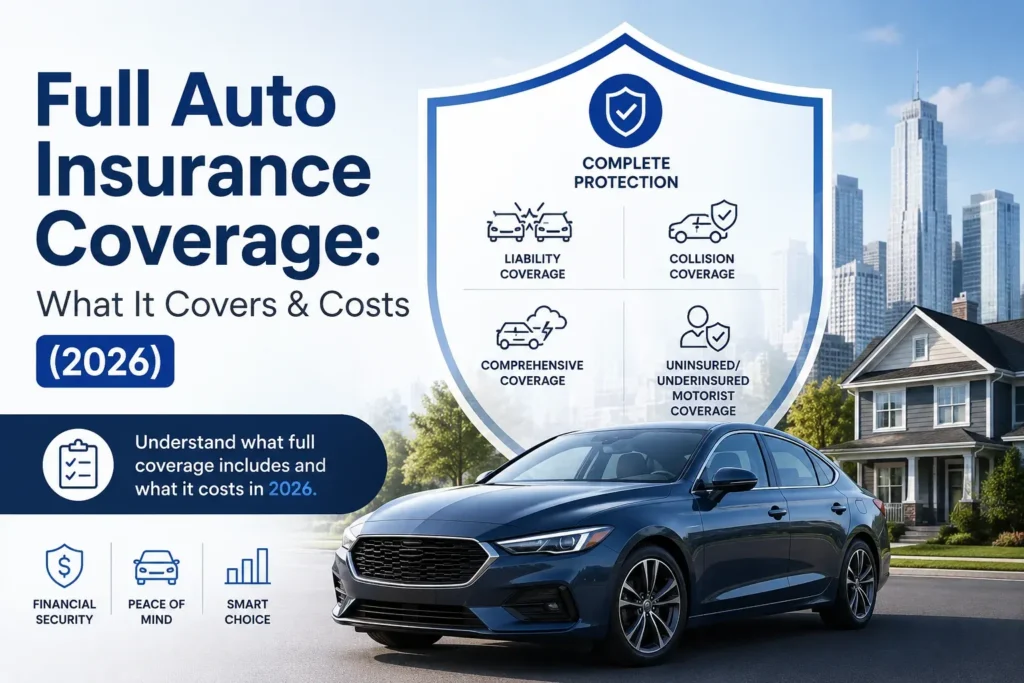
Full auto insurance coverage typically combines three major types of protection:
Coverage | Purpose |
Liability Insurance | Pays for injuries and property damage you cause to others. |
Collision Coverage | Pays to repair or replace your own vehicle after a collision. |
Comprehensive Coverage | Covers non-collision damage such as theft, fire, hail, vandalism, floods, or falling objects. |
Many insurance companies also allow you to add optional protections like roadside assistance, rental car reimbursement, gap insurance, and uninsured motorist coverage for even greater financial protection.
What Is Full Auto Insurance Coverage?
Full auto insurance coverage is a combination of multiple insurance protections designed to cover both your vehicle and your financial responsibility if an accident occurs.
Unlike liability-only insurance, which only pays for damages you cause to other people, full coverage also helps pay for repairs to your own vehicle in many situations.
Although “full coverage” is a common term, there is no official insurance policy called full coverage. Instead, insurers bundle different coverages together to provide broader protection.
A standard full coverage policy usually includes:
- Liability Coverage
- Collision Coverage
- Comprehensive Coverage
Some insurers may recommend additional optional coverages depending on where you live, the value of your vehicle, and your driving habits.
What Does Full Auto Insurance Coverage Include?
Understanding each component helps you know exactly what you’re paying for.
Liability Insurance
Liability insurance is required in almost every U.S. state. It pays for injuries or property damage you cause to someone else when you’re responsible for an accident.
It generally includes:
- Bodily Injury Liability
- Property Damage Liability
Example
You accidentally rear-end another vehicle at a traffic light.
Your liability insurance may pay for:
- Medical bills for injured passengers
- Repairs to the other driver’s vehicle
- Legal expenses if you’re sued
However, liability insurance does not pay for repairs to your own vehicle.
Collision Coverage
Collision insurance pays for damage to your own vehicle after a collision, regardless of who caused the accident.
Covered situations include:
- Hitting another vehicle
- Crashing into a tree
- Striking a guardrail
- Rolling your vehicle
Example
You slide on an icy road and hit a concrete barrier.
Collision coverage can help pay for repairing your vehicle after you pay your deductible.
Comprehensive Coverage
Comprehensive insurance protects your vehicle against events that are not caused by a collision.
Typical covered events include:
- Vehicle theft
- Fire damage
- Hailstorms
- Flooding
- Falling trees
- Broken windshields
- Animal collisions
- Vandalism
Example
A severe hailstorm damages your parked vehicle.
Instead of paying thousands of dollars out of pocket, comprehensive insurance helps cover the repair costs after your deductible.
What Isn’t Covered by Full Auto Insurance?
Many drivers assume “full coverage” means every possible expense is covered. Unfortunately, that’s a common misconception.
Here are some situations that are usually not covered:
Not Covered | Why |
Routine maintenance | Considered normal vehicle ownership expenses |
Oil changes | Maintenance responsibility |
Tire wear | Normal wear and tear |
Mechanical breakdowns | Covered by warranties, not insurance |
Engine failure from age | Not considered accidental damage |
Intentional damage | Insurance excludes intentional acts |
Racing accidents | High-risk activities are excluded |
Personal belongings inside the vehicle | Often covered under homeowners or renters insurance instead |
Reading your policy carefully is important because coverage details vary between insurance providers.
Who Should Buy Full Auto Insurance Coverage?
While not legally required in every situation, full coverage makes sense for many drivers.
It is often recommended if:
- Your vehicle is less than 10 years old.
- Your car has a high market value.
- You’re financing or leasing your vehicle.
- You rely on your car every day.
- You couldn’t easily afford major repair bills.
- You live in an area with high theft or severe weather.
Drivers with newer vehicles generally benefit the most because repair or replacement costs can be significant.
Benefits of Full Auto Insurance Coverage
Choosing full coverage offers several important advantages beyond meeting lender requirements.
Better Financial Protection
Accidents, theft, and natural disasters can result in repair bills worth thousands of dollars. Full coverage helps reduce these unexpected expenses.
Peace of Mind
Knowing your vehicle is protected against many common risks allows you to drive with greater confidence.
Protection Against Weather
Many areas in the United States experience hail, hurricanes, flooding, wildfires, or falling trees. Comprehensive coverage helps protect against these unpredictable events.
Required by Most Lenders
If you’re financing or leasing a vehicle, your lender will usually require collision and comprehensive coverage until the loan is paid off.
How Much Does Full Auto Insurance Coverage Cost in the USA?
The cost of full auto insurance coverage varies depending on several factors, including your age, driving history, vehicle, location, and the insurance company you choose.
While premiums differ from one driver to another, the average cost of full coverage in the United States generally falls within the following range:
Driver Profile | Estimated Annual Premium |
Safe driver with clean record | $1,400–$2,000 |
Average driver | $2,000–$2,800 |
Young driver (under 25) | $3,500–$6,000+ |
Driver with accidents or violations | $3,000–$5,500+ |
Note: These are estimated averages. Your actual premium may be higher or lower based on your individual risk profile and state.
Factors That Affect Your Full Coverage Insurance Premium
Insurance companies calculate premiums by evaluating how likely you are to file a claim. The lower your perceived risk, the lower your premium is likely to be.
1. Driving Record
Your driving history is one of the biggest pricing factors.
Drivers with:
- No accidents
- No speeding tickets
- No DUI convictions
usually receive the lowest insurance rates.
2. Age
Younger drivers generally pay more because they have less driving experience and statistically file more claims.
Older drivers with a long history of safe driving often qualify for better rates.
3. Location
Where you live matters.
Insurance premiums may increase if your area has:
- High accident rates
- Heavy traffic
- Frequent vehicle theft
- Severe weather
- Higher repair costs
Urban areas often have higher premiums than rural communities.
4. Vehicle Type
Insurance companies also consider:
- Vehicle value
- Repair costs
- Theft rates
- Safety features
- Engine performance
Luxury and sports cars usually cost more to insure than standard family vehicles.
5. Credit-Based Insurance Score
In many U.S. states, insurers use a credit-based insurance score when determining premiums.
Drivers with stronger credit histories may receive lower rates, while lower scores can result in higher premiums where this practice is allowed.
6. Annual Mileage
The more you drive, the greater the chance of an accident.
Drivers who use their vehicle only occasionally often qualify for lower premiums than daily commuters.
How to Save Money on Full Auto Insurance Coverage
Having full coverage doesn’t necessarily mean paying the highest possible premium. Smart shopping and good driving habits can make a big difference.
Compare Multiple Quotes
Never buy the first policy you receive.
Comparing quotes from several insurance companies helps you find better pricing and coverage options.
Increase Your Deductible
Choosing a higher deductible usually lowers your monthly premium.
However, make sure you can comfortably afford the deductible if you need to file a claim.
Bundle Insurance Policies
Many insurers offer discounts when you purchase multiple policies together, such as:
- Auto insurance
- Homeowners insurance
- Renters insurance
- Motorcycle insurance
Bundling can often reduce your overall insurance costs.
Maintain a Clean Driving Record
Avoiding accidents and traffic violations can help you qualify for safe-driver discounts over time.
Ask About Available Discounts
Many insurance companies offer discounts for:
- Safe driving
- Defensive driving courses
- Multi-vehicle policies
- Good students
- Military members
- Veterans
- Low annual mileage
- Automatic payments
- Paperless billing
Always ask your insurer which discounts you qualify for.
Full Coverage vs. Liability-Only Insurance
Choosing between liability-only insurance and full coverage depends on your vehicle’s value, financial situation, and personal risk tolerance.
Feature | Full Coverage | Liability Only |
Covers damage to your own vehicle |
|
|
Covers theft |
|
|
Covers vandalism |
|
|
Covers weather damage |
|
|
Covers collision damage |
|
|
Meets minimum legal requirements |
|
|
Lower monthly premium |
|
|
Best for newer vehicles |
|
|
Best for older, low-value vehicles | Sometimes |
|
 Yes
Yes No
NoUnderstanding Insurance Deductibles
A deductible is the amount you agree to pay out of pocket before your insurance company pays the remaining covered costs.
Example
Suppose your collision deductible is $500, and repairing your vehicle after an accident costs $3,000.
Here’s how the payment works:
Repair Cost | Your Deductible | Insurance Pays |
$3,000 | $500 | $2,500 |
A higher deductible generally lowers your premium, but it also means paying more if you file a claim.
Is Full Auto Insurance Coverage Worth It?
For many drivers, the answer is yes—especially if they own a newer or more valuable vehicle.
Full coverage can be a smart investment if:
- You cannot easily afford major repair bills.
- Your car is financed or leased.
- Your vehicle has a high resale value.
- You rely on your car for work or daily transportation.
- You live in an area with frequent storms, theft, or vandalism.
However, if your vehicle is older and worth only a few thousand dollars, paying for collision and comprehensive coverage may not always be cost-effective. Compare the annual premium with the car’s current market value before making a decision.
Common Mistakes to Avoid
Many drivers make costly insurance decisions simply because they don’t understand their policy.
Avoid these common mistakes:
- Assuming “full coverage” means every situation is covered.
- Choosing the cheapest policy without comparing coverage.
- Selecting a deductible you can’t afford.
- Forgetting to update your policy after buying a new vehicle.
- Not reviewing your policy at renewal time.
- Ignoring available discounts.
- Failing to compare quotes before renewing.
Expert Tips
- Review your insurance policy at least once a year.
- Increase your liability limits if you have significant assets to protect.
- Keep proof of insurance easily accessible.
- Document vehicle damage with photos after an accident.
- File claims promptly when necessary.
- Ask your insurer about new discounts at every renewal.
Real-World Example
Imagine Sarah purchases a three-year-old SUV with a loan from her bank. A few months later, a severe hailstorm damages the roof, hood, and windshield. Because she has comprehensive coverage as part of her full auto insurance policy, she only pays her deductible while the insurer covers the remaining repair costs. Without comprehensive coverage, Sarah would have been responsible for the entire repair bill herself.
Key Takeaways
- Full auto insurance coverage is not a single policy but a combination of liability, collision, and comprehensive insurance.
- It offers broader financial protection than liability-only coverage.
- It does not cover routine maintenance, normal wear and tear, or mechanical failures.
- Costs vary based on driving history, vehicle type, location, age, and other factors.
- Comparing quotes and using available discounts can help reduce premiums.
- Full coverage is often the best choice for newer, financed, or higher-value vehicles.
Conclusion
Full auto insurance coverage provides valuable financial protection against many of the risks drivers face every day. While it may cost more than liability-only insurance, the added protection can save you thousands of dollars after an accident, theft, or severe weather event.
Before purchasing a policy, compare quotes from several insurers, review coverage limits, and choose a deductible that fits your budget. Taking the time to understand your options helps ensure you get the right level of protection without paying for coverage you don’t need.
Whether you’re buying your first policy or reviewing your current one, selecting the right full auto insurance coverage can provide confidence every time you get behind the wheel.
Frequently Asked Questions (FAQs)
Is full auto insurance coverage required by law?
No. Most U.S. states only require drivers to carry minimum liability insurance. However, if you’re financing or leasing your vehicle, your lender will usually require collision and comprehensive coverage until the loan is paid off.
Does full coverage insurance include roadside assistance?
Not automatically.
Roadside assistance is typically an optional add-on that may cover:
- Flat tire changes
- Jump-starts
- Fuel delivery
- Lockout service
- Towing
Check your policy to see whether it’s included.
Does full coverage pay for engine failure?
No.
Insurance generally does not cover:
- Mechanical breakdowns
- Engine wear
- Transmission failure due to age
- Normal maintenance issues
These are usually covered by a manufacturer’s warranty or an extended vehicle service contract, not auto insurance.
Will full coverage replace my car if it’s totaled?
Yes, if the vehicle is declared a total loss due to a covered event.
The insurance company typically pays the actual cash value (ACV) of the vehicle, minus your deductible. If you owe more on your loan than the car is worth, gap insurance may help cover the remaining balance.
Does full coverage include rental car reimbursement?
Usually not.
Rental reimbursement is an optional coverage that helps pay for a rental vehicle while your car is being repaired after a covered claim.
Is full coverage worth it for an older car?
It depends on the car’s value.
If your vehicle has a low market value, the annual cost of collision and comprehensive coverage may exceed the benefit. Compare the premium with the vehicle’s current value before deciding.
Can I lower my full coverage insurance premium?
Yes. Common ways to reduce costs include:
- Compare quotes from multiple insurers.
- Maintain a clean driving record.
- Raise your deductible (if affordable).
- Bundle insurance policies.
- Ask about available discounts.
- Improve your credit-based insurance score where applicable.
- Drive fewer miles if possible.